PRJ-01 · AI Personal Finance Platform
FinPilot AI
One place for every account. One AI for your finances.
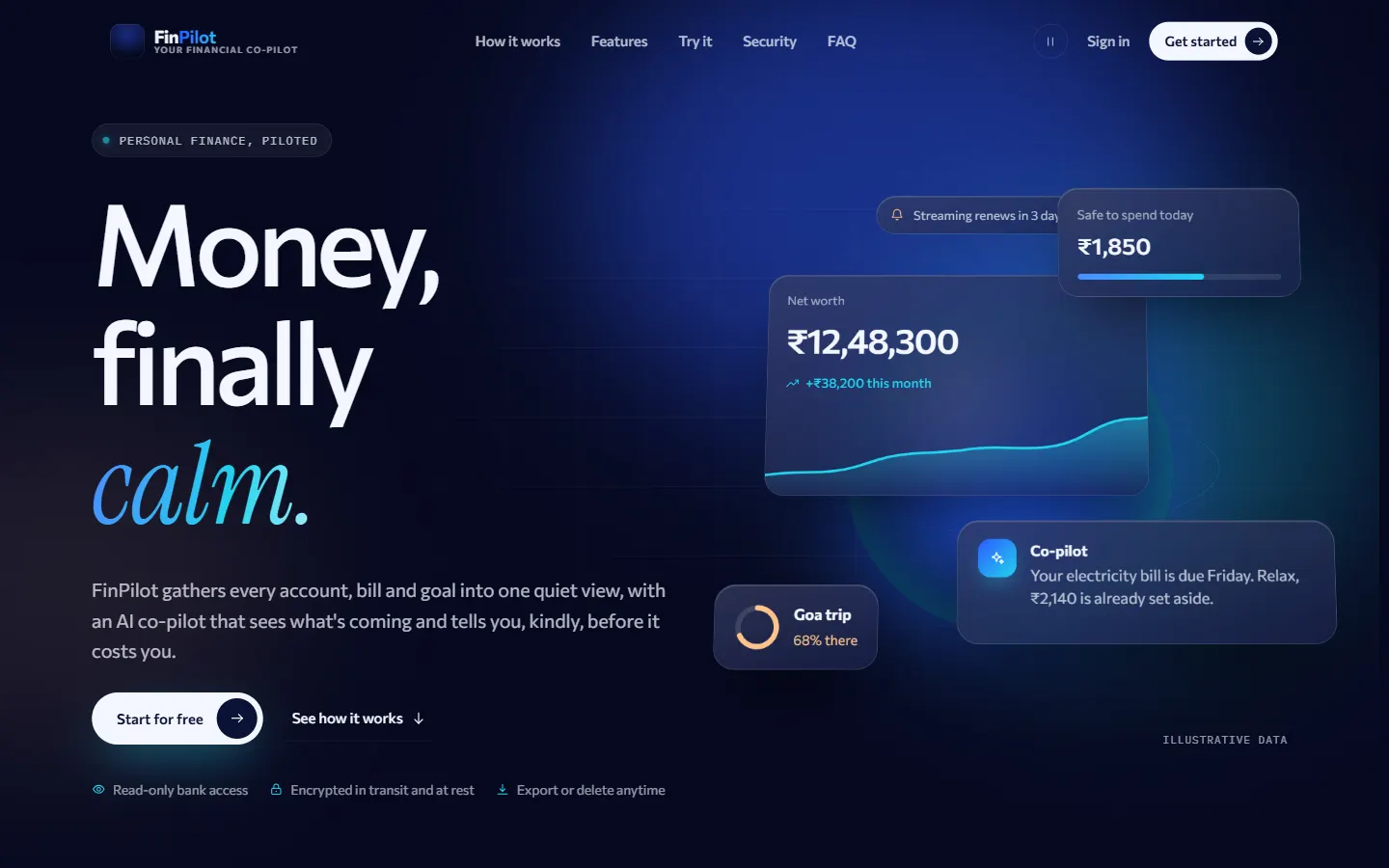
Every account in one dashboard, plus an AI Copilot that answers money questions from the user’s real numbers — with a fraud-risk engine, cash-flow forecast and health score.
Runs on generated demo data — real bank connections are not built yet.
The problem
Money lives across bank apps, cards, investments, loans, UPI and subscriptions. Simple questions — how much do I actually have, can I afford this, is this charge suspicious — have no single place to be answered.
The approach
Unify every account into one model, then put an AI Copilot on top that can only read data through validated, audited tools. The user ID is injected on the server, never taken from the model, and every number on screen comes from a tool result — not from generated text.
The outcome
A financial command center on 12 months of deterministic demo data: net worth, explainable fraud flags, a forecast with stated assumptions and a 0–100 health score — all answerable in chat.
Key features
- 01
AI Copilot
Streaming chat with read-only tools over balances, spending, budgets, bills, forecasts and risk signals. Modes for Security, Money, Analytics, Goals and Search.
- 02
Fraud & risk engine
Each transaction scored by statistical rules — amount outliers, new merchants, foreign location, unusual hours, velocity bursts — with plain explanations and “That’s me” / report actions.
- 03
Smart categorisation
Five stages: user rules → ~300 seeded Indian merchants → pattern rules → batched, cached AI classification (each merchant hits the model once) → uncategorised.
- 04
Cash-flow forecast
60-day projection with a lowest-balance warning and a “Can I afford it?” check that lists its assumptions.
- 05
Financial health score
A 0–100 score built from six sub-scores — savings, debt, credit use, budget adherence, emergency fund, cash flow — each with its reasons.
- 06
Budgets, goals & bills
Recurring payments detected automatically, including price-hike alerts. A Privacy Center shows exactly which data the AI can read.
Engineering highlights
- 01
AI safety by design
Server-injected user ID, zod-validated tool arguments, tool data wrapped as untrusted against prompt injection, every tool call audit-logged, and refusal of personalised investment advice.
- 02
Answers you can check
Charts and cards render from tool results, not the model’s text — so the numbers can’t be made up.
- 03
Deterministic demo data
A seeded generator builds 12 months of realistic Indian banking data for one persona, with planted fraud scenarios, so screenshots and evals stay stable.
- 04
Money as bigint
No floating-point rounding errors anywhere; INR formatting throughout.
- 05
Security-first
Argon2 hashing, JWT, TOTP MFA, Google and Apple OAuth with PKCE, rate limiting, Helmet headers, encrypted secrets and generic client errors.
- 06
Accessible & translatable
Every user-facing string goes through translation files; light and dark themes with switchable colour palettes.
Tech stack
- Frontend
- Next.js 16, React 19, TypeScript, TanStack Query, Recharts, Motion, next-intl
- Backend
- NestJS, Prisma, PostgreSQL, Redis, BullMQ
- AI
- Provider-agnostic LLM layer — Anthropic, OpenAI and a mock provider for tests
- Auth
- Argon2, JWT (jose), TOTP MFA, Google & Apple OAuth (PKCE)
- Monorepo
- pnpm workspaces, Turborepo, shared zod contracts, bigint money package
- Quality
- Vitest, Testcontainers integration tests, AI eval suite, ESLint, Prettier